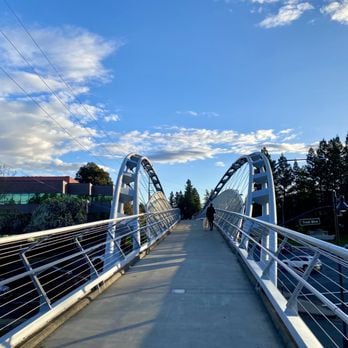
At Treat Boulevard and Jones Road, next to the Pleasant Hill/Contra Costa Centre BART station, a cable-and-pipe span has carried the Iron Horse Trail over Treat since 2010. It is closed now. Contra Costa County Public Works closed the Robert I. Schroder Pedestrian Bridge on Monday, October 5, and plans to keep it closed through Thursday, December 31, 2026, unless something unforeseen comes up.
Walkers, runners and cyclists coming down the trail now use the street crossing on Treat. The Contra Costa Transportation Authority described the bridge as the product of more than a decade of planning, and its cost came close to $13 million, all to give the trail a safer way over Treat. For the rest of 2026, the street crossing is back.
Crews Work at Night, but the Bridge Is Closed All Day
Contra Costa County's September 24 release sets work hours of 9 p.m. to 5 a.m., Sunday through Thursday, excluding holidays and weather permitting. The bridge stays closed to trail users around the clock for the whole project, as the release states:
"The Bridge will be closed for the duration of the project. Pedestrian and bicycle users on the Iron Horse Trail will be redirected to the existing street crossing on Treat Boulevard for approximately 3-4 months while the bridge is closed for repairs. Detour signs will guide users around the construction."
The East Bay Regional Park District's Iron Horse Trail page, last updated October 14, gives the same dates. It calls the bridge section of the trail closed for the full period.
What | Schedule |
|---|---|
Bridge closed to trail users | October 5 through December 31, 2026, all hours |
Active construction | 9 p.m. to 5 a.m., Sunday through Thursday |
Driver impact on Treat | Expected 10-minute delays, occasional lane closures |
Full nighttime closures of Treat | About four nights, roughly a 5-mile vehicle detour |
Trail hours outside the bridge | 5 a.m. to 10 p.m. unless posted |
The county hasn't published dates for those four full closures yet. Its release says they will appear on the project page. If you drive Treat after dark, check that page before you rely on it.
The Bridge Was Moved a Block East for Trail Users
Before the closure, people crossing at Jones Road had a reason to be there. The original plan put the overpass at Treat and Oak Road. The East Bay Times reported in August 2010 that the project was moved one block east "to also serve the several thousand bicyclists who use the Iron Horse Trail every month."
That move made the bridge part of the trail. The Contra Costa Transportation Authority described it in 2010 as a link between disconnected sections of the Iron Horse and a safer way across heavily traveled Treat Boulevard. The architect's own description adds a third purpose. Beyond the trail itself, the bridge connects a commuter rail station and high-density development.
When it opened on a Saturday in October 2010, the Mercury News described a span 240 feet long and weighing 500,000 pounds. The paper put annual use of the full 24-mile Iron Horse, from Dublin to Concord, at more than 1 million people. The bridge is named for Robert I. Schroder. He was a longtime Walnut Creek mayor and a Contra Costa County supervisor. He also served on the Metropolitan Transportation Commission and was founding chair of the transit authority that became County Connection, according to the Martinez News-Gazette. A bridge named for a transit man sits beside a BART station. The fit is intentional.
Building It Meant Working Around a Corridor Full of Utilities
The Jones Road site suited trail users, but it was hard ground to build on. Jim Kennedy, then the county's redevelopment director, walked the East Bay Times through what was in the way:
- PG&E tension lines about 30 feet overhead
- A water line, a couple of sewer lines, fiber optics and TV cable underground
- A high-pressure fuel line
"When you identify where all those features are and try to put a bridge and support posts in, it's like threading a needle from about 30,000 feet," Kennedy told the paper.
The best spot for the south support post sat directly over a sewer line that the concrete's weight would have crushed. "We effectively had to build an underground bridge over the sewer," Kennedy said. "So, as it turned out, we built a bridge on a bridge." The south landing also took over part of Jones Road, so Jones was closed during construction. To handle the traffic that moved to Oak Road, crews added a right-turn lane for northbound drivers approaching Treat.
The look of the bridge was put to a public vote. An earlier, cheaper proposal called for a plain concrete vault. In an online survey, respondents chose the cable design. The East Bay Times summed it up as "style over savings."
All of this added cost. The project was budgeted at about $7 million, and the East Bay Times reported the final bill was closer to $12 million, with the extra money coming from county, state and federal sources. Published figures differ. Engineering News-Record reported $6.8 million at the opening. The Contra Costa Transportation Authority's December 2011 project fact sheet lists a total of $12.751 million. That total includes $5.296 million in federal CMAQ funds, $1.380 million in escalated Measure C funds, $246,000 in STIP transportation enhancement funds and $5.829 million in other local money.
What the 2026 Rehab Covers
Sixteen years after it opened, the bridge is getting maintenance. According to the county's release, the work includes:
- Replacing the bearing pads
- Repairing the paint
- Treating the bridge deck
- Replacing the sidewalks and curbs on the bridge
The bid documents also list traffic control, spot blasting and cleaning before paint repairs, and fixes for concrete spalling. The Walnut Creek Record described the purpose as addressing serviceability and aesthetics. The bearing pads explain the four nights when Treat closes to cars. Replacing them is the work that requires the road to shut.
On August 11, 2026, the Board of Supervisors awarded the contract to Disney Construction, Inc. for $1,136,020. Funding is 55% Measure X, 18% District IV allocated Measure X and 27% park dedication funds. You may also see $1.185 million in coverage. That was the county engineer's pre-bid estimate, made up of an $805,000 base bid and two additive bids of $195,000 and $185,000. It was not the awarded contract.
Compared with the $12.751 million total in CCTA's 2011 fact sheet, the awarded contract is a little under 9% of what the bridge cost to build. The price of a quieter fix is three months of trail users crossing Treat at street level.
Planning Around the Closure Through December 31
As of the October 14 park district update, the bridge is still on track to reopen when the year ends, barring unforeseen circumstances. Until then, here is what to keep in mind:
- On foot or bike: Follow the detour signs to the existing street crossing on Treat. The bridge sits on the east side of the Jones Road intersection, and detour signs guide users around the construction.
- BART connections: If you usually ride or walk the trail to the Pleasant Hill/Contra Costa Centre station, allow extra time to cross Treat at street level in both directions.
- Driving Treat at night: Sunday through Thursday after 9 p.m., expect delays of about 10 minutes and occasional lane closures. On the four full-closure nights, expect a detour of about 5 miles. Those dates will be posted on the county's project page.
- Trail hours: The rest of the Iron Horse keeps its regular 5 a.m. to 10 p.m. hours unless posted otherwise.
- Questions: The park district lists 888-EBPARKS (888-327-2757), option 3, extension 4533, for the Iron Horse Trail.
A $1.1 million maintenance job that keeps a $12 million bridge in service for years to come is a reasonable trade for a stretch of trail that people use every day. If you own a home near the Iron Horse or Contra Costa Centre and want to know how trail access, transit and projects like this one factor into your property's value, Jill Fusari offers a confidential home valuation grounded in local knowledge of the area.